Limp mode only. Drive to shop; no towing until diagnosed. U0101 means the ECM has lost communication with the transmission control module (TCM) on the CAN bus and is no longer receiving the expected data frames from it.
What U0101 means
On all modern electronically controlled automatic transmissions, the transmission control module and the engine control module exchange data continuously via the vehicle's CAN bus. The TCM sends the ECM gear position, torque reduction requests, shift status, and TCC lockup commands; the ECM sends the TCM engine speed, throttle position, and driver demand data. When the ECM stops receiving the expected CAN message frames from the TCM — either because the TCM has gone offline, the bus wiring has failed, or the TCM's power supply has been interrupted — it stores U0101. Because the two modules are so closely coupled during gear changes and torque management, U0101 typically causes immediate and severe symptoms: the transmission enters failsafe mode, and the ECM adjusts engine torque output based on whatever default assumptions it can make without TCM data.
Symptoms
- Check engine light and/or transmission warning light on
- Transmission locked in a single gear (limp mode) — no shifting
- Harsh engagement when selecting Drive or Reverse
- Loss of cruise control (requires ECM-TCM coordination)
- Torque converter lockup (TCC) disabled — elevated RPM at highway speed
- Multiple warning lights on simultaneously (ABS, traction control, stability control may also illuminate as secondary effects)
Common causes
- Blown fuse or failed relay powering the TCM, causing it to go entirely offline — the most common and easiest to check first
- Corroded, loose, or damaged connector at the TCM itself, breaking the CAN bus connection
- Broken CAN High or CAN Low wire between the TCM and the CAN bus network — chafing at frame rails or near hot components is a common location
- Failed TCM with an internal power supply or CAN transceiver fault that prevents it from communicating
- Low battery voltage or a poor chassis/engine ground degrading CAN bus signal integrity to the point where the TCM's messages are lost
- Wiring harness damage in the transmission area — harnesses routed near exhaust or moving drivetrain components are susceptible to chafing
Severity & driving advice
Severity: High — Transmission in limp mode or no-shift state. Requires a full-system scanner that can communicate with all modules to diagnose.
Can I drive? Limp mode only. Drive to shop; no towing until diagnosed.
Diagnostic approach
- Check the TCM fuse and relay immediately — Locate the TCM power and ignition fuses in the underhood or interior fuse box using the vehicle's fuse chart. A blown fuse takes the TCM entirely offline and explains U0101 without any other cause. Replace any blown fuses and inspect the corresponding circuit for a short before assuming the TCM itself has failed.
- Check battery voltage and all chassis grounds — Measure battery voltage with the engine off (should be 12.4–12.6V) and running (13.8–14.4V). Inspect the main battery ground cable at both the battery terminal and the chassis attachment point. A corroded or loose ground can drop CAN bus voltage enough to cause communication failures without setting a battery or charging system code.
- Inspect the TCM connector and wiring — Locate the TCM (typically mounted in the engine bay near the firewall, or in the cabin under the dashboard depending on the vehicle). Unplug the TCM connector and inspect all terminals for corrosion, bent pins, or backed-out terminals. Repin any corroded contacts using correct terminal repair tools. Test the CAN High and CAN Low circuit continuity from the TCM connector back to the OBD-II port — an open in either wire removes the TCM from the network.
- Verify CAN bus termination resistance at the OBD-II port — With all modules powered off (key out), measure resistance between pin 6 (CAN High) and pin 14 (CAN Low) at the OBD-II port. The reading should be close to 60 ohms — two 120-ohm end-of-line resistors in parallel. A reading of 120 ohms indicates one termination resistor is missing or one half of the bus is disconnected. Infinite resistance indicates a complete CAN bus break on that network.
Estimated repair costs
Typical US repair costs (parts & labour) for the faults behind U0101. These are national-average estimates, not a quote— your actual price varies by region, shop labour rate, and your vehicle’s make, model and year. Figures reviewed 2026.
| Repair | Estimated cost (USD) |
|---|---|
| Fuse or relay replacement | $10–$40 |
| Wiring/connector repair (corrosion or open circuit) | $80–$400 |
| TCM replacement | $400–$1,200 |
| TCM programming after replacement | $100–$300 |
| Professional CAN bus / module diagnosis | $100–$200 |
Make & model notes
Chrysler / Dodge / Jeep: TCM location depends on the transmission, so don't assume an engine-bay module. On LX cars (Dodge Charger and Magnum, Chrysler 300) with the NAG1 (W5A580) 5-speed, the TCM is a cabin module under the left side of the instrument panel on left-hand-drive cars (mirrored to the right side on RHD) — it shares a bracket with the radio amplifier as a single assembly, so reaching it means dropping the amplifier/TCM unit (three screws, four connectors). Its power runs through a transmission relay and a fuse in the rear power-distribution centre in the trunk, so one blown fuse there can drop the TCM off the CAN bus entirely and set U0101 with the module simply absent from the scan tool — check that fuse and relay before condemning the TCM. By contrast, cars with the 42RLE 4-speed have no separate TCM at all: it is built into the PCM in the right rear of the engine compartment, which is the layout the old 'engine-bay TCM connector' advice actually describes.
General Motors: GM trucks and SUVs (2003–2009 Silverado, Sierra, Tahoe) generate U0101 from TCM connector corrosion at the transmission harness bulkhead connector on the driver's side of the transmission case. Pulling the connector and inspecting for green oxidation on the pins is the first diagnostic step before any module testing.
Ford: Ford vehicles with the 6R80 or 5R110 transmission (F-150, Super Duty) occasionally develop U0101 from wiring harness chafing along the transmission crossmember where the harness routing is exposed to road debris. Inspect the harness for protective loom damage in this area before condemning the TCM.
Real-world case: U0101 with a module missing from the scan (FCA / LX platform)
Vehicle: 2007 Dodge Charger SRT8 — 6.1L HEMI, NAG1 (W5A580) 5-speed automatic· a diagnosis from our own workshop
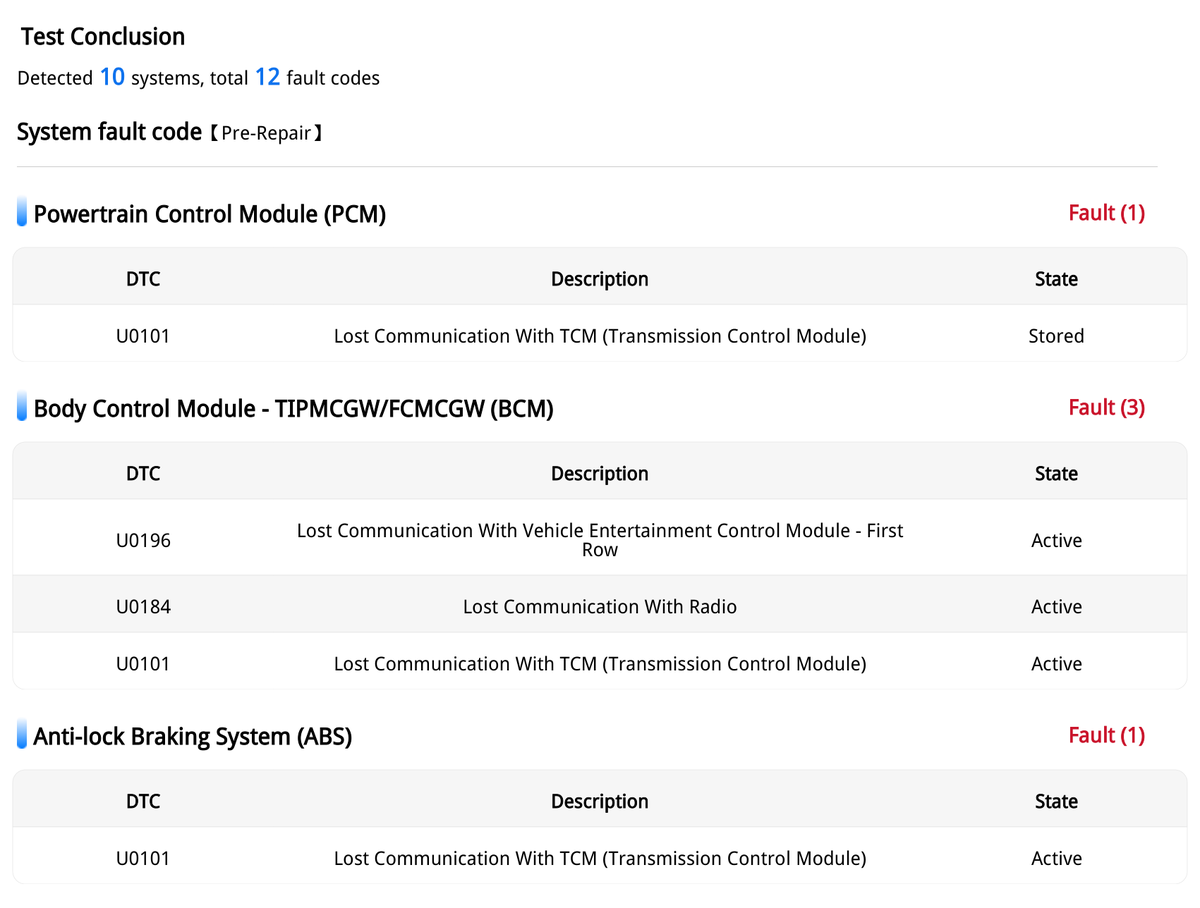
Complaint. The car arrived in limp-home mode. A full-system scan returned twelve fault codes spread across seven modules — enough to look, at first glance, like a major network failure.
Reading past the twelve codes, only three were unique: U0101 (lost communication with the TCM, reported by the PCM, ABS and BCM), U0184 (lost communication with the radio) and U0196 (lost communication with the rear-seat video module). The body module reported all three because it houses the central gateway that bridges the two CAN buses.
The decisive observation came from the scanner's module list, not the codes: the TCM and the radio were completely absent from it, while eight of the ten remaining modules answered normally. That argues against a dead bus — a shorted or open CAN backbone would knock out far more than two specific modules on two different buses. What we had instead was two individual participants that had simply dropped off the network.
We cleared the codes and re-read a few minutes later. Only U0101 came back, and only as a pending code in the PCM — which fits how this monitor runs: the PCM evaluates it only with the engine actually running and won't set it hard until several consecutive seconds pass with no message from the TCM. Restarting brought the rest of the codes back, confirming these were live faults and not stored history.
Because the TCM was not on the bus at all, the usual U0101 decision path — which opens by asking whether the TCM is awake and communicating — did not apply. We switched to the 'no response from module' approach, which points at the module's power and ground before its data wiring. The factory wiring confirmed the logic. This platform splits its fusing between an underhood power-distribution centre (the TIPM) and a second power-distribution centre in the trunk, and the transmission control circuit is fed from the rear one — through the transmission relay and a single fuse. Lose that feed and the TCM has no power at all — absent from the bus, with the transmission dropped into limp mode — which was exactly the picture in front of us.
Root cause. Two blown fuses in the rear power-distribution centre (PDC) in the trunk, under the spare-wheel panel. Cavity 37, a 15 A fuse, fed the transmission/TCM circuit — that one explains U0101. Cavity 36, a 20 A fuse, fed both the radio and the rear video monitor from a single supply — which is why U0184 and U0196 always appeared together. They were never two separate faults, just one shared fuse. The amplifier sat on a different fuse and stayed online throughout. Both fuses had been popped by a short in aftermarket rear-accessory wiring added in the trunk and mis-terminated to ground.
Resolution. We replaced both fuses and re-scanned. The module count went from ten to fourteen — the TCM, radio, video module and wireless control module were all back on the bus — with zero active codes. One detail worth knowing: the airbag control module still held U0184 and U0196 as stored (not active) history. A 'clear all modules' command usually skips the airbag module, so those had to be cleared explicitly before the car read fully clean.
Takeaway: When a U-code names a module that is entirely missing from the scanner's module list — not just throwing a code — suspect a power-supply problem (a blown fuse or a lost feed) before you chase the CAN wiring or condemn the module. And when two communication codes always appear as a pair, check whether a single fuse feeds both circuits: it is often one fault, not two.
FAQ
What is the difference between U0100 and U0101?
U0100 is a lost communication fault with the ECM or PCM (the primary engine controller). U0101 is a lost communication fault specifically with the TCM (the transmission controller). Both are CAN bus communication codes and share the same diagnostic approach — check power, grounds, wiring, and then the module itself — but they point to different offline modules.
Can I diagnose U0101 with a basic OBD-II reader?
No. A basic code reader reads only the engine (powertrain) module. U0101 requires a full-system scan tool that can independently attempt to communicate with the TCM module. If the TCM is completely offline, even a professional scanner will be unable to communicate with it directly — that inability itself confirms the module is not present on the bus.
My TCM fuse keeps blowing — what does that mean?
A repeatedly blown TCM fuse indicates a short circuit in the TCM power supply wiring or an internal TCM failure drawing excessive current. Do not simply replace the fuse repeatedly with a higher-rated fuse. Trace the TCM power circuit for chafed wiring shorting to ground, or have the TCM tested for an internal power supply fault.
Will U0101 clear itself after fixing the wiring?
Once the TCM is back online and communicating normally, U0101 will require clearing with a scan tool. It does not self-clear even after the fault is repaired. Some modules will re-establish communication immediately after the connector is repaired; others require a key cycle. Clear the code, cycle the ignition, and confirm the TCM is visible in the scan tool's module list before confirming the repair.